For being possivel to all the readers to accompany the analyses of the plays that we will do, I start to explain how the annotation is carried out in chess.
The system used at present is the Algebraic annotation, this system numbers the eight Lines from 1 to 8 and eight Columns of A to H, the annotation is always carried out from the White's point of view.

To write down a play, each player registers his move and the adversary's move.
To write down the move:
1st - It Is Written down by capital letter, the initial of the Piece that was moved;
2nd - Next, with small letter, the square for where the piece moved.
Important: The square is identified writing first, with small letter, the corresponding Column of the square, following the corresponding number of the Line that belongs to target square of the piece.
1st - There Is Written down the initial of the Piece that moved;
2nd - following it's Written down an "X", that is the sign of capture;
3rd - finally, it's written down the square of the Captured Piece.
Obs.: 1-It's not necessary to write down the name of the captured piece, just identify correcly the square where the captured piece was.
2-when the piece is a Pawn, it is not necessary to write the initial of the Piece. So, whenever a move is written down without the initial capital letter, it is already known that is a Pawn's move.
It is written down normally the movement of the Pawn up to the final rank. After the written down move, there is registered a sign of equality (=) and the initial capital letter of the new piece that is promoted. Ex.: c8=Q or cxd8=R. In the first case, the Pawn who was in c7 advanced for c8 and promoted a Queen; in the second case, the Pawn who was in c7, captured a piece (Knight e.g.) in d8 and the Rook was promoted. In both cases, the player is free to chose what piece is promoted.
Example:
White, Black
1- e4, e5
2 - Nf3, Nc6
Conventional signs: There are several signs used during the play or in annotations of the play, with the objective to point out determined specific aspect of the move. Let's see the most used ones:
.
Captures x
Check +
Checkmate ++
Good move !
Very good move !!
Bad move ?
Very bad move ??
Castle King Side 0-0
Castle Queen Side 0-0-0
' en passant ' e.p.
Proposal of Draw (=)
.
Attention: It is very common among beginners not wanting to write down the plays because of thinking that it loses the concentration (generally, in tournaments among not federated).
.
NEVER THIS MISTAKE IS ALLOWED!
.
The accomodation of this task, it obstructs the player of later to analyse the play and to correct the committed mistakes. Then, if his wish is to become a good player, it follows the example of the best.
.
WRITE DOWN YOUR PLAY!
.
It still can happen, that the habit of writing down the moves favors the development of the concentration. So that, the annotation of the play, it must always be stimulated.

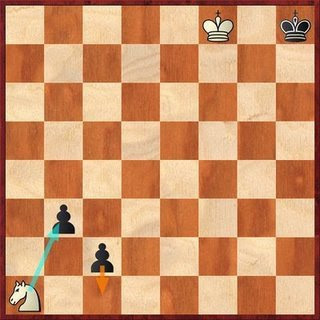 In this position the white Knight is at one of the extremities of the board and can move only for 2 squares where there are the black Pawns


 Posts
Posts


